Pearl Harbor Video of Japenese Soilder Reading a Letter He Wrote to His Father
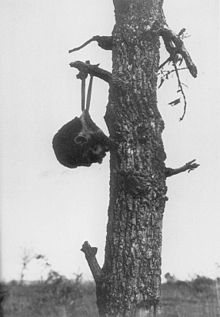
1945 image of a Japanese soldier'south severed head hung on a tree co-operative, presumably by American troops.[i] [2]

Sign with skull on Tarawa, Dec 1943

Hospital sign warning most fail of Atabrine handling, Guinea Globe War II
During World War 2, some members of the United States military mutilated dead Japanese service personnel in the Pacific theater. The mutilation of Japanese service personnel included the taking of torso parts as "war souvenirs" and "war trophies". Teeth and skulls were the most commonly taken "trophies", although other body parts were too nerveless.
The phenomenon of "bays-taking" was widespread plenty that discussion of it featured prominently in magazines and newspapers. Franklin Roosevelt himself was reportedly given a gift of a letter of the alphabet-opener made of a Japanese soldier's arm past U.S. Representative Francis E. Walter in 1944, which Roosevelt later ordered to be returned, calling for its proper burying.[3] [4] The news was besides widely reported to the Japanese public, where the Americans were portrayed equally "deranged, primitive, racist and inhuman". This, compounded by a previous Life mag flick of a young woman with a skull trophy, was reprinted in the Japanese media and presented equally a symbol of American barbarism, causing national shock and outrage.[5] [6]
The behavior was officially prohibited by the U.S. military, which issued additional guidance as early as 1942 condemning it specifically.[7] Still, the behavior was hard to prosecute[ citation needed ] and it connected throughout the war in the Pacific theater, and has resulted in connected discoveries of "bays skulls" of Japanese combatants in American possession, besides equally American and Japanese efforts to repatriate the remains of the Japanese dead.
Trophy-taking [edit]
A number of immediate accounts, including those of American servicemen, attest to the taking of body parts as "trophies" from the corpses of Royal Japanese troops in the Pacific Theater during World War Two. Historians have attributed the miracle to a entrada of dehumanization of the Japanese in the U.Southward. media, to various racist tropes latent in American guild, to the depravity of warfare under desperate circumstances, to the inhuman cruelty of Imperial Japanese forces, lust for revenge, or whatsoever combination of those factors.[ citation needed ] The taking of then-called "trophies" was widespread enough that, by September 1942, the Commander in Main of the Pacific Armada ordered that "No part of the enemy'south body may be used as a souvenir", and any American servicemen violating that principle would face "stern disciplinary activity".[viii]
Trophy skulls are the nigh notorious of the souvenirs. Teeth, ears and other such trunk parts were also taken and were occasionally modified, such as past writing on them or fashioning them into utilities or other artifacts.[9]
Eugene Sledge relates a few instances of fellow marines extracting gilt teeth from the Japanese, including ane from an enemy soldier who was nevertheless live.
But the Japanese wasn't dead. He had been wounded severely in the dorsum and couldn't motility his arms; otherwise he would have resisted to his last jiff. The Japanese'due south oral cavity glowed with huge aureate-crowned teeth, and his captor wanted them. He put the signal of his kabar on the base of a tooth and striking the handle with the palm of his manus. Considering the Japanese was kicking his anxiety and thrashing nearly, the knife point glanced off the tooth and sank deeply into the victim's mouth. The Marine cursed him and with a slash cut his cheeks open to each ear. He put his foot on the sufferer's lower jaw and tried again. Blood poured out of the soldier's rima oris. He fabricated a gurgling dissonance and thrashed wildly. I shouted, "Put the man out of his misery." All I got for an reply was a cussing out. Another Marine ran up, put a bullet in the enemy soldier'due south brain, and ended his agony. The scavenger grumbled and connected extracting his prizes undisturbed.[10]
U.S. Marine Corps veteran Donald Fall attributed the mutilation of enemy corpses to hatred and desire for vengeance:
On the second 24-hour interval of Guadalcanal we captured a big Jap bivouac with all kinds of beer and supplies ... But they also establish a lot of pictures of Marines that had been cutting up and mutilated on Wake Island. The next matter you know there are Marines walking around with Jap ears stuck on their belts with condom pins. They issued an order reminding Marines that mutilation was a court-martial offense ... Y'all get into a nasty frame of mind in gainsay. You see what'due south been done to you. Yous'd find a dead Marine that the Japs had booby-trapped. We plant dead Japs that were booby-trapped. And they mutilated the dead. Nosotros began to get down to their level.[11]

Front line warning sign using a Japanese soldier's skull on Peleliu October 1944
Another example of mutilation was related by Ore Marion, a U.Southward. marine who suggested that soldiers became "like animals" under harsh conditions:
We learned virtually savagery from the Japanese ... But those xvi-to-19-year old kids we had on the Culvert were fast learners ... At daybreak, a couple of our kids, bearded, dirty, skinny from hunger, slightly wounded by bayonets, dress worn and torn, wack off three Jap heads and jam them on poles facing the "Jap side" of the river ... The colonel sees Jap heads on the poles and says, "Jesus men, what are you doing? You're acting like animals." A dingy, stinking immature child says, "That's right Colonel, we are animals. We live like animals, we eat and are treated like animals–what the fuck practice you await?"[11]
On February one, 1943, Life mag published a photograph taken by Ralph Morse during the Guadalcanal campaign showing a severed Japanese caput that U.S. marines had propped up below the gun turret of a tank. Life received messages of protest from people "in disbelief that American soldiers were capable of such brutality toward the enemy." The editors responded that "state of war is unpleasant, cruel, and inhuman. And information technology is more dangerous to forget this than to exist shocked by reminders." Withal, the image of the severed head generated less than one-half the number of protest letters that an prototype of a mistreated cat in the very same issue received, suggesting that American backlash was not significant.[12] Years afterwards, Morse recounted that when his platoon came upon the tank with the caput mounted on it, the sergeant warned his men not to approach it equally it might accept been gear up by the Japanese in guild to lure them in, and he feared that the Japanese might have a mortar tube zeroed in on it. Morse recalled the scene in this style: "'Everybody stay away from there,' the sergeant says, then he turns to me. 'You,' he says, 'become accept your picture if you have to, then become out, quick.' So I went over, got my pictures and ran like hell back to where the patrol had stopped."[13]
In October 1943, the U.South. Loftier Command expressed warning over recent paper manufactures roofing American mutilation of the dead. Examples cited included one where a soldier made a string of beads using Japanese teeth and another about a soldier with pictures showing the steps in preparing a skull, involving cooking and scraping of the Japanese heads.[vii]

In 1944, the American poet Winfield Townley Scott was working as a reporter in Rhode Island when a sailor displayed his skull bays in the paper part. This led to the poem The U.S. sailor with the Japanese skull, which described one method for preparation of skulls for trophy-taking, in which the head is skinned, towed in a cyberspace behind a ship to clean and polish it, and in the end scrubbed with caustic soda.[14]
Charles Lindbergh refers in his diary entries to several instances of mutilations. In the entry for August 14, 1944, he notes a chat he had with a Marine officer who claimed that he had seen many Japanese corpses with an ear or olfactory organ cut off.[vii] In the case of the skulls, nonetheless, most were not collected from freshly killed Japanese; most came from already partially or fully decayed and skeletonised bodies.[7] Lindbergh also noted in his diary his experiences from an air base of operations in New Guinea, where, co-ordinate to him, the troops killed the remaining Japanese stragglers "as a sort of hobby" and often used their leg-basic to carve utilities.[ix]
Moro Muslim guerillas on Mindanao fought against Nippon in World War Two. The Moro Muslim Datu Pino sliced the ears off Japanese soldiers and cashed them in with the American guerilla leader Colonel Fertig at the exchange charge per unit of a pair of ears for one bullet and 20 centavos (equivalent to $1.44 in 2020).[15] [sixteen] [17]
Extent of do [edit]
According to Weingartner it is non possible to decide the percentage of U.S. troops that collected Japanese torso parts, "only it is articulate that the exercise was non uncommon."[xviii] According to Harrison just a minority of U.S. troops collected Japanese body parts as trophies, just "their behaviour reflected attitudes which were very widely shared."[7] [18] According to Dower, most U.S. combatants in the Pacific did not engage in "gift hunting" for trunk parts.[19] The majority had some knowledge that these practices were occurring, however, and "accepted them as inevitable nether the circumstances."[19] The incidents of soldiers collecting Japanese body parts occurred on "a scale large enough to business organisation the Centrolineal armed services government throughout the conflict and was widely reported and commented on in the American and Japanese wartime printing."[20] The caste of credence of the practice varied between units. Taking of teeth was generally accustomed by enlisted men and also by officers, while credence for taking other trunk parts varied greatly.[7] In the experience of 1 serviceman turned writer, Weinstein, ownership of skulls and teeth were widespread practices.[21]
There is some disagreement betwixt historians over what the more common forms of "trophy hunting" undertaken past U.S. personnel were. John W. Dower states that ears were the about common course of trophy that was taken, and skulls and bones were less ordinarily collected. In particular he states that "skulls were not popular trophies" as they were difficult to carry and the process for removing the mankind was offensive.[22] This view is supported by Simon Harrison.[7] In contrast, Niall Ferguson states that "humid the flesh off enemy [Japanese] skulls to brand souvenirs was not an uncommon practice. Ears, bones and teeth were also nerveless".[23] When interviewed by researchers, former servicemen recounted that the practise of taking gold teeth from the dead – and sometimes also from the living – was widespread.[24]
The collection of Japanese trunk parts began quite early on in the campaign, prompting a September 1942 guild for disciplinary action against such souvenir taking.[7] Harrison concludes that since the Battle of Guadalcanal was the first real opportunity to take such items, "Clearly, the collection of body parts on a scale large plenty to concern the military authorities had started as shortly as the first living or dead Japanese bodies were encountered."[7] When Charles Lindbergh passed through customs at Hawaii in 1944, i of the customs declarations he was asked to make was whether or non he was carrying whatever bones. He was told subsequently expressing some shock at the question that it had become a routine signal,[25] because of the large number of gift bones discovered in customs, likewise including "green" (uncured) skulls.[26]
In 1984, Japanese soldiers' remains were repatriated from the Mariana Islands. Roughly sixty pct were missing their skulls.[26] Likewise information technology has been reported that many of the Japanese remains on Iwo Jima are missing their skulls.[26]
Information technology is possible that the souvenir collection of remains connected into the immediate mail-war period.[26]
Context [edit]
According to Simon Harrison, all of the "bays skulls" from the Earth War II era in the forensic record in the U.S., attributable to an ethnicity, are of Japanese origin; none come from Europe.[ix] A seemingly rare exception to this rule was the case of a German soldier scalped by an American soldier in films shot by the Special Movie Project 186[27] nearly Prague, Czechoslovakia, on May eight, 1945, displaying an M4 Sherman with a skull and bones fixed to it,[28] which was falsely attributed to a Winnebago tribal custom.[29] Skulls from World War II, and as well from the Vietnam War, continue turning up in the U.S., sometimes returned by erstwhile servicemen or their relatives, or discovered past law. According to Harrison, opposite to the situation in average head-hunting societies, the trophies practise not fit in American guild. The taking of the objects was socially accepted at the time, but later on the war, when the Japanese in fourth dimension became seen as fully human again, the objects for the nearly office became seen as unacceptable and unsuitable for display. Therefore, in time they and the practice that had generated them were largely forgotten.[26]
Australian soldiers as well mutilated Japanese bodies at times, most ordinarily by taking gilt teeth from corpses.[xxx] That was officially discouraged by the Australian Regular army.[30] Johnston states that "ane could argue that greed rather than hatred was the motive" for this behavior, just "utter contempt for the enemy was likewise present."[30] Australians are also known to accept taken gold teeth from German language corpses, "only the practice was obviously more than common in the South-West Pacific."[30] "The vast majority of Australians clearly institute such behavior abhorrent, but "some of the soldiers who engaged in it were not "hard cases".[xxx] According to Johnston, Australian soldiers' "unusually murderous behavior" towards their Japanese opponents (such as killing prisoners) was acquired by "racism", a lack of understanding of Japanese military machine culture (which also considered the enemy, especially those who surrendered, equally unworthy of compassion) and, most significantly, a desire to take revenge against the murder and mutilation of Australian prisoners and native New Guineans during the Boxing of Milne Bay and subsequent battles.[31]
From the Burma Campaign, there are recorded instances of Democracy troops removing gilded teeth and displaying Japanese skulls as trophies.[32]
Motives [edit]
Dehumanization [edit]

U.S. government propaganda poster from WWII featuring a Japanese soldier depicted as a rat
In the U.South., there was a widely propagated view that the Japanese were subhuman.[33] [34] There was also popular anger in the U.S. at the Japanese surprise attack on Pearl Harbor, amplifying pre-war racial prejudices.[23] The U.Due south. media helped propagate this view of the Japanese, for example describing them as "yellow vermin".[34] In an official U.S. Navy film, Japanese troops were described as "living, snarling rats".[35] The mixture of underlying American racism, which was added to by U.Due south. wartime propaganda, hatred caused past the Japanese state of war of assailment, and both existent and as well fabricated Japanese atrocities, led to a general loathing of the Japanese.[34] Although there were objections to the mutilation from amidst other military jurists, "to many Americans the Japanese adversary was no more than an animal, and corruption of his remains carried with it no moral stigma".[36]
According to Niall Ferguson: "To the historian who has specialized in German history, this is i of the near troubling aspects of the Second World State of war: the fact that Allied troops oftentimes regarded the Japanese in the same way that Germans regarded Russians—equally Untermenschen."[37] Since the Japanese were regarded equally animals, it is not surprising that Japanese remains were treated in the same way as brute remains.[34]
Simon Harrison comes to the decision in his paper, "Skull trophies of the Pacific War: transgressive objects of remembrance", that the minority of U.South. personnel who collected Japanese skulls did so because they came from a guild that placed much value in hunting equally a symbol of masculinity, combined with a de-humanization of the enemy.[38]
State of war correspondent Ernie Pyle, on a trip to Saipan later the invasion, claimed that the men who actually fought the Japanese did not subscribe to the wartime propaganda: "Soldiers and Marines have told me stories by the dozen about how tough the Japs are, nevertheless how dumb they are; how casuistic and yet how uncannily smart at times; how piece of cake to rout when disorganized, all the same how brave ... Every bit far as I tin see, our men are no more afraid of the Japs than they are of the Germans. They are afraid of them equally a modern soldier is agape of his foe, simply non because they are slippery or rat-like, but simply because they have weapons and fire them like good, tough soldiers."[39]
Brutalization [edit]
Some writers and veterans land that body parts trophy and souvenir taking was a side effect of the brutalizing effects of a harsh campaign.[40]
Harrison argues that, while brutalization could explain part of the mutilations, it does not explicate servicemen who, fifty-fifty before shipping off for the Pacific, proclaimed their intention to acquire such objects.[41] According to Harrison, it also does not explain the many cases of servicemen collecting the objects as gifts for people back home.[41] Harrison concludes that there is no prove that the average serviceman collecting this type of souvenirs was suffering from "combat fatigue". They were normal men who felt that was what their loved ones wanted them to collect for them.[four] Skulls were sometimes also nerveless as souvenirs by non-combat personnel.[40]
A young Marine recruit, who had arrived on Saipan with his buddy Al in 1944, after the island was secure, provides an eyewitness account. After a brief firefight the night earlier, he and a minor grouping of other marines find the body of a straggler who had apparently shot himself:
I would have guessed that the dead Japanese was only about fourteen years old and at that place he lay dead. My thoughts turned to some mother back in Japan who would receive word that her son had been killed in battle. Then one of the Marines, who I found out after had been through other campaigns, reached over and roughly grabbed the Japanese soldier by the belt and ripped his shirt off. Somebody said, 'What are you looking for?' And he said, 'I'm looking for a money belt. Japs ever carry money belts.' Well, this Jap didn't. Another Marine veteran of gainsay saw that the dead soldier had some aureate teeth, so he took the butt of his rifle and banged him on the jaw, hoping to extract the gold teeth. Whether he did or not I don't know, because at that point I turned around and walked away. I went over to where I thought no one would see me and sat down. Although my optics were dry, inside my eye was wrenching, not at seeing the expressionless soldier, but at seeing the way some of my comrades had treated that dead body. That bothered me a great deal. Pretty soon Al came over and sat down abreast me and put his arm around my shoulder. He knew what I was feeling. When I turned to look at Al he had tears running downward his face.[42]
Revenge [edit]
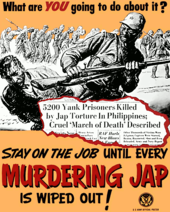
News of the Bataan Death March sparked outrage in the United states of america, as shown past this propaganda poster
Bergerud writes that U.S. troops' hostility towards their Japanese opponents largely arose from incidents in which Japanese soldiers committed war crimes against Americans, such as the Bataan Expiry March and other incidents conducted by individual soldiers. For example, Bergerud states that the U.S. marines on Guadalcanal were aware that the Japanese had beheaded some of the marines captured on Wake Island prior to the commencement of the campaign. Withal, that type of cognition did non necessarily lead to revenge mutilations. Ane marine states that they falsely thought the Japanese had non taken whatsoever prisoners at Wake Island and then equally revenge, they killed all Japanese that tried to surrender.[43] [44]
According to one marine, the earliest business relationship of U.S. troops wearing ears from Japanese corpses took place on the second twenty-four hours of the Guadalcanal Campaign in August 1942 and occurred subsequently photos of the mutilated bodies of marines on Wake Isle were constitute in Japanese engineers' personal furnishings. The account of the same marine likewise states that Japanese troops booby-trapped some of their own dead as well as some dead marines and also mutilated corpses; the consequence on marines beingness "We began to get down to their level".[xi] According to Bradley A. Thayer, referring to Bergerud and interviews conducted past Bergerud, the behaviors of American and Australian soldiers were affected by "intense fear, coupled with a powerful lust for revenge".[45]
Weingartner writes, however, that U.S. marines were intent on taking gold teeth and making keepsakes of Japanese ears already while they were en route to Guadalcanal.[46]
Souvenirs and bartering [edit]
Factors relevant to the collection of torso parts were their economic value, the desire both of the "folks back home" for a souvenir and of the servicemen themselves to have a keepsake when they returned habitation.
Some of the collected souvenir basic were modified: turned into letter-openers, and may exist an extension of trench art.[ix]
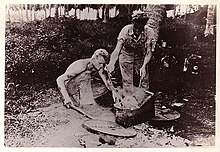
Skull stewing-Pacific War
Pictures showing the "cooking and scraping" of Japanese heads may accept formed part of the large gear up of Guadalcanal photographs sold to sailors which were circulating on the U.Southward. West-coast.[47] According to Paul Fussel, pictures showing this type of activity, i.e. humid human heads, "were taken (and preserved for a lifetime) because the Marines were proud of their success".[14]
According to Weingartner, some of the U.Due south. marines who were about to take office in the Guadalcanal Campaign were already while they were en route looking frontward to collecting Japanese gold teeth for necklaces and to preserving Japanese ears every bit souvenirs.[eighteen]
In many cases (and unexplainable by battlefield conditions) the collected trunk parts were not for the use of the collector but instead meant to be gifts to family unit and friends at dwelling house,[41] in some cases as the effect of specific requests from home.[41] Newspapers reported of cases such as a female parent requesting permission for her son to ship her an ear or a bribed clergyman that was promised by an underage youth "the third pair of ears he collected."[41]
Another case of that type of press is Yank, which, in early 1943, published a cartoon showing the parents of a soldier receiving a pair of ears from their son.[47] In 1942, Alan Lomax recorded a dejection song where a soldier promises to send his kid a Japanese skull, and a tooth.[41] Harrison also makes note of the Congressman that gave President Roosevelt a letter-opener carved out of bone as examples of the social range of these attitudes.[4]
Trade sometimes occurred with the items, such every bit "members of the Naval Structure Battalions stationed on Guadalcanal selling Japanese skulls to merchant seamen" equally reported in an Allied intelligence study from early 1944.[40] Sometimes teeth (particularly the less common gold teeth) were also seen as a tradable commodity.[40]
U.S. reaction [edit]
"Stern disciplinary action" against human being remains souvenir taking was ordered by the Commander-in-Chief of the Pacific Armada equally early as September 1942.[7] In October 1943 Full general George C. Marshall radioed Full general Douglas MacArthur about "his business organisation over current reports of atrocities committed by American soldiers".[48] In January 1944 the Joint Chiefs of Staff issued a directive against the taking of Japanese body parts.[48] Simon Harrison writes that directives of this type may have been constructive in some areas, "but they seem to have been implemented just partially and unevenly past local commanders".[7]

May 22, 1944, Life mag Picture of the Calendar week, "Arizona war worker writes her Navy boyfriend a thank-you lot-note for the Jap skull he sent her"
On May 22, 1944, Life mag published a photo[49] of an American girl with a Japanese skull sent to her by her naval officer boyfriend. The image caption stated: "When he said goodbye two years ago to Natalie Nickerson, 20, a war worker of Phoenix, Ariz., a large, handsome Navy lieutenant promised her a Jap. Last calendar week Natalie received a homo skull, autographed by her lieutenant and 13 friends, and inscribed: "This is a practiced Jap – a dead one picked up on the New Guinea beach." Natalie, surprised at the gift, named information technology Tojo. The letters Life received from its readers in response to this photo were "overwhelmingly condemnatory"[50] and the Regular army directed its Bureau of Public Relations to inform U.S. publishers that "the publication of such stories would exist probable to encourage the enemy to take reprisals against American dead and prisoners of war".[51] The junior officer who had sent the skull was also traced and officially reprimanded.[4] This was, however, done reluctantly, and the penalization was not severe.[52]
The image was widely reprinted in Japan every bit anti-American propaganda.[53]
The Life photograph as well led to the U.S. war machine taking further action against the mutilation of Japanese corpses. In a memorandum dated June 13, 1944, the Army JAG asserted that "such awful and fell policies" in addition to being repugnant also were violations of the laws of war, and recommended the distribution to all commanders of a directive pointing out that "the maltreatment of enemy war dead was a blatant violation of the 1929 Geneva Convention on the Ill and Wounded, which provided that: After each engagement, the occupant of the field of battle shall accept measures to search for the wounded and dead, and to protect them against pillage and maltreatment." Such practices were in addition also in violation of the unwritten customary rules of country warfare and could lead to the death penalty.[54] The Navy JAG mirrored that opinion one week later, and also added that "the atrocious conduct of which some U.Due south. servicemen were guilty could lead to retaliation past the Japanese which would be justified under international law".[54]
On June 13, 1944, the printing reported that President Roosevelt had been presented with a letter-opener fabricated out of a Japanese soldier'due south arm bone past Francis Eastward. Walter, a Democratic congressman.[four] Supposedly, the president commented, "This is the sort of gift I like to become", and "There'll be plenty more such gifts".[55] Several weeks later on it was reported that it had been given back with the caption that the President did non want this type of object and recommended information technology be cached instead. In doing so, Roosevelt was acting in response to the concerns which had been expressed by the military machine authorities and some of the noncombatant population, including church leaders.[4]
In October 1944, the Right Rev. Henry St. George Tucker, the Presiding Bishop of the Episcopal Church building in the United States of America, issued a argument which deplored "'isolated acts of desecration with respect to the bodies of slain Japanese soldiers and appealed to American soldiers as a grouping to discourage such actions on the role of individuals".[56] [57]
Japanese reaction [edit]
News that President Roosevelt had been given a os letter-opener by a congressman was widely reported in Nihon. The Americans were portrayed as "deranged, primitive, racist and inhuman". That reporting was compounded by the previous May 22, 1944, Life magazine flick of the week publication of a young adult female with a skull trophy, which was reprinted in the Japanese media and presented as a symbol of American barbarism, causing national shock and outrage.[v] [6] Military history author Edwin P. Hoyt argues that two U.Due south. media reports of Japanese skulls and basic being sent dorsum to the U.S. were exploited very effectively by Japanese propaganda. These actions contrasted starkly with the Shinto religion's accent on respectful treatment of human being remains. This aspect of Shinto, combined with the propaganda spotlight on American atrocities, contributed straight to the mass suicides on Saipan and Okinawa later the Centrolineal landings.[v] [58] According to Hoyt, "The idea of a Japanese soldier'southward skull becoming an American ashtray was every bit horrifying in Tokyo every bit the thought of an American prisoner used for bayonet practice was in New York."[59]
See also [edit]
- Anti-Japanese sentiment
- Fence over the atomic bombings of Hiroshima and Nagasaki
- Headhunting
- Jap hunts
- Maywand District murders
- Rape during the occupation of Japan
- Statism in Shōwa Japan
- Unit of measurement 100, Unit 516, Unit 731
References [edit]
- ^ Roeder, George H. Jr. (Fall 1995). "Missing on the dwelling front". National Forum. Archived from the original on October 18, 2016 – via Questia.
- ^ Lewis A. Erenberg; Susan E. Hirsch (May 15, 1996). The War in American Culture: Society and Consciousness During World War II. University of Chicago Press. p. 52. ISBN978-0-226-21511-ii.
- ^ Weingartner 1992, p. 65.
- ^ a b c d e f Harrison 2006, p. 825.
- ^ a b c Harrison 2006, p. 833.
- ^ a b Dickey, Colin (2012). Afterlives of the Saints: Stories from the Ends of Faith. ISBN9781609530723.
- ^ a b c d due east f g h i j g Harrison 2006, p. 827.
- ^ Paul Fussell. Wartime: Understanding and Behavior in the 2nd World State of war. 1990, page 117
- ^ a b c d Harrison 2006, p. 826.
- ^ (With the Old Breed: At Peleliu and Okinawa. p. 120
- ^ a b c Thayer 2004, p. 186.
- ^ "State of war, Journalism, and Propaganda"
- ^ Ben Cosgrove (Feb 19, 2014). "Guadalcanal: Rare and Archetype Photos From a Pivotal WWII Entrada". Time. Archived from the original on Nov xiv, 2014. Retrieved October 17, 2016.
- ^ a b Harrison 2006, p. 822.
- ^ Keats, John (1990). They Fought Solitary. p. 285. ISBN9780809485543.
- ^ McClintock, Michael (1992). Instruments of Statecraft: U.S. Guerrilla Warfare, Counterinsurgency, and Counter-terrorism, 1940-1990. p. 93. ISBN9780394559452.
- ^ Tucci, Frank (2009). The Old Muslim'south Opinions: A Year of Filipino Paper Columns. p. 130. ISBN9781440183423.
- ^ a b c Weingartner 1992, p. 56.
- ^ a b Dower 1986, p. 66.
- ^ Harrison 2006, p. 818.
- ^ Harrison 2006, pp. 822, 823.
- ^ Dower 1986, p. 65.
- ^ a b Ferguson 2007, p. 546.
- ^ Film exposes Allies' Pacific state of war atrocities Horrific footage shot during battle with Japanese shows execution of wounded and bayoneting of corpses. Jason Burke The Observer, Sunday June iii, 2001
- ^ Dower 1986, p. 71.
- ^ a b c d due east Harrison 2006, p. 828.
- ^ Chasing Hitler YouTube
- ^ "Liberated Czechoslovakia; Wounded and Dead Germans; POWS". Steven Spielberg Movie and Video Archive. Retrieved October 17, 2016.
- ^ The Taking and Displaying of Human Body Parts As Trophies by Amerindians. Chacon and Dye, page 625 ISBN 9780387483030
- ^ a b c d due east Johnston 2000, p. 82.
- ^ Johnston 2000, pp. 81–100.
- ^ T. R. Moreman "The jungle, the Japanese and the British Commonwealth armies at war, 1941–45", p. 205
- ^ Weingartner 1992, p. 67.
- ^ a b c d Weingartner 1992, p. 54.
- ^ Weingartner 1992, p. 54 Japanese were alternatively described and depicted as "mad dogs", "yellow vermin", termites, apes, monkeys, insects, reptiles and bats etc.
- ^ Weingartner 1992, pp. 66, 67.
- ^ Ferguson 2007, p. 182.
- ^ Harrison 2006.
- ^ Ernie Pyle (Feb 26, 1945). "The Casuistic Japs". Rocky Mountain News. Retrieved October 17, 2016 – via Indiana University.
- ^ a b c d Harrison 2006, p. 823.
- ^ a b c d eastward f Harrison 2006, p. 824.
- ^ Bruce Niggling, Saipan: Oral Histories of the Pacific War, McFarland & Visitor, Inc., 2002, ISBN 0-7864-0991-6, p 119
- ^ Stanley Coleman Jersey "Hell's islands: the untold story of Guadalcanal", p. 169, 170
- ^ See also: Allied state of war crimes during World War Two#Asia and the Pacific State of war
- ^ Thayer 2004, p. 185.
- ^ Weingartner 1992, p. 556.
- ^ a b Weingartner 1992, pp. 56, 57.
- ^ a b Weingartner 1992, p. 57.
- ^ "Picture of the Calendar week". Life. Time Inc. May 22, 1944. p. 35. ISSN 0024-3019. Retrieved August 8, 2010.
- ^ Weingartner 1992, p. 58.
- ^ Weingartner 1992, p. threescore.
- ^ Weingartner 1992, pp. 65, 66.
- ^ Curley, John J. (2012). "Bad Manners: A 1944 Life Magazine "Flick of the Calendar week"". Visual Resources. 28 (3): 240–262. doi:10.1080/01973762.2012.702659. S2CID 194083703.
- ^ a b Weingartner 1992, p. 59.
- ^ Drew Pearson (June 13, 1944). "Jones-Clayton Forces Behind Texas Revolt". THE WASHINGTON MERRY-GO-ROUND. The Nevada Daily Post.
- ^ "Tucker Deplores Desecration of Foe; Mutilation of Japanese Bodies Contrary to Spirit of Regular army, He Says of 'Isolated' Cases". The New York Times. October 14, 1944.
- ^ "The Morals of Victory". Time. Oct 23, 1944. Archived from the original on October 24, 2012. Retrieved May 11, 2008.
- ^ Hoyt (1987), pp. 357–361
- ^ Hoyt (1987), pp. 358
Sources [edit]
- Weingartner, James J. (February 1992). "Trophies of War: U.South. Troops and the Mutilation of Japanese War Dead, 1941-1945". Pacific Historical Review. 61 (1): 53–67. doi:x.2307/3640788. JSTOR 3640788. Archived from the original on August xi, 2011. Retrieved August 11, 2011.
U.S. Marines on their way to Guadalcanal relished the prospect of making necklaces of Japanese gilt teeth and 'pickling' Japanese ears equally keepsakes.
- Harrison, Simon (2006). "Skull Trophies of the Pacific War: transgressive objects of remembrance". Periodical of the Imperial Anthropological Plant. 12 (4): 817–836. doi:10.1111/j.1467-9655.2006.00365.x.
- Thayer, Bradley A. (2004). Darwin and international relations: on the evolutionary origins of war and ethnic conflict. University Press of Kentucky. ISBN978-0-8131-2321-9 . Retrieved Jan 24, 2011.
- Johnston, Marking (2000). Fighting the Enemy. Australian Soldiers and their Adversaries in World War II. Melbourne: Cambridge Academy Press. ISBN0-521-78222-8 . Retrieved January 24, 2011.
- Dower, John W. (1986). War Without Mercy. Race and Power in the Pacific War. London: Faber and Faber. pp. 64–66. ISBN0-571-14605-8 . Retrieved January 24, 2011.
- Ferguson, Niall (2007). The War of the Globe. History's Age of Hatred. London: Penguin Books. ISBN978-0-xiv-101382-four . Retrieved January 24, 2011.
Further reading [edit]
- Paul Fussell "Wartime: Agreement and Behavior in the 2nd Globe War" ISBN 9780195065770
- An Intimate History of Killing. p. 37–43. ISBN9780465007387.
- Fussel "Thank God for the Atom Bomb and other essays" (pages 45–52) ISBN 9780786103959
- Aldrich "The Faraway War: Personal diaries of the Second World State of war in Asia and the Pacific" ISBN 9780385606790
- Hoyt, Edwin P. (1987). Japan's War: The Peachy Pacific Conflict. London: Arrow Books. ISBN0-09-963500-three.
- Charles A. Lindbergh (1970). The Wartime Journals of Charles A. Lindbergh . Harcourt Caryatid Jovanovich, Inc. ISBN0-fifteen-194625-half dozen.
External links [edit]
- One War Is Enough State of war Correspondent EDGAR L. JONES 1946
- Fenton, Ben (Baronial 6, 2005). "American troops 'murdered Japanese PoWs'". The Telegraph. Archived from the original on January fourteen, 2013. Retrieved July 14, 2021.
- The Us Sailor with the Japanese Skull past Winfield Townley Scott
- Boorstein, Michelle (July three, 2007). "Eerie Souvenirs From the Vietnam State of war". The Washington Post.
- 2002 Virginia Festival of the Book: Trophy Skulls
- Weingartner, James (Bound 1996). "War against Subhumans: Comparisons between the German language War against the Soviet Matrimony and the American War confronting Japan, 1941-1945". The Historian. Taylor & Francis Ltd. 58 (3): 557–573. doi:x.1111/j.1540-6563.1996.tb00964.ten. JSTOR 24449433.
- Brcak, Nancy; Pavia, John R. (Summertime 1994). "Racism in Japanese and U.South. Wartime Propaganda". The Historian. Taylor & Francis Ltd. 56 (4): 671–684. doi:10.1111/j.1540-6563.1994.tb00926.x. JSTOR 24449072.
- "Macabre Mystery: Coroner tries to observe origin of skull found during raid by deputies". The Pueblo Chieftain.
- Allen, David (May 13, 2004). "Skull from WWII prey to exist buried in grave for Japanese unknown soldiers". Stars and Stripes . Retrieved July xiv, 2021.
- HNET review of Peter Schrijvers. The GI State of war against Nippon: American Soldiers in Asia and the Pacific during World War II.
- "A Japanese solider'southward skull is propped up on a burned-out Jap tank by U.South. troops. Fire destroyed the remainder of the corpse". Life. February 1, 1943. p. 27.
- The May 1944 Life magazine picture of the calendar week (image)
Source: https://en.wikipedia.org/wiki/American_mutilation_of_Japanese_war_dead
0 Response to "Pearl Harbor Video of Japenese Soilder Reading a Letter He Wrote to His Father"
Post a Comment